
BioBoost™ GeoChem
Chelated Iron Delivery for Controlled Formation of Reactive Iron Sulfides (FeS)
Improves iron stability, transport, and downgradient reactivity to enhance biogeochemical remediation.
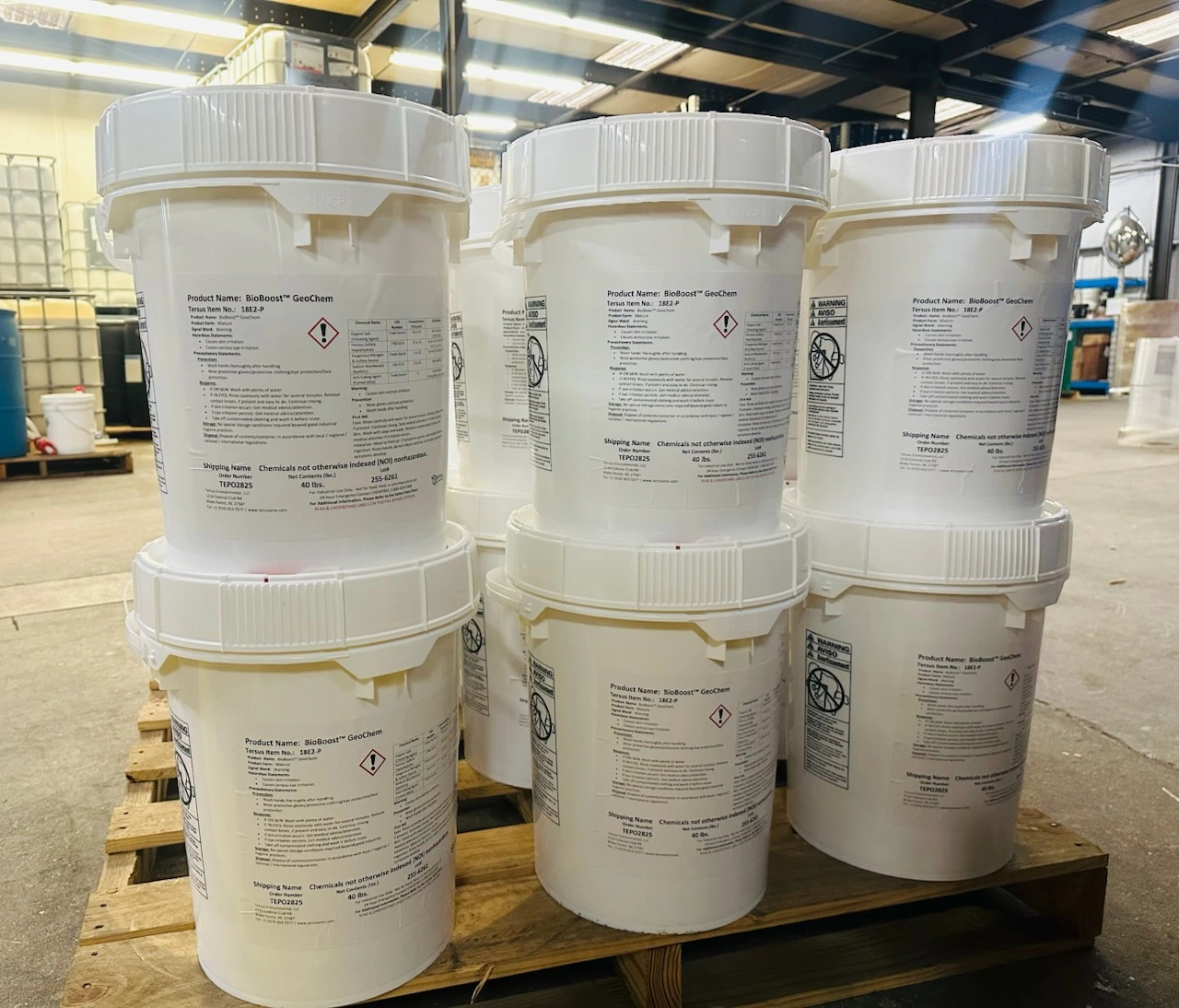 Product Overview
BioBoost™ GeoChem is a geochemical amendment designed to control the stability, transport, and reactivity of dissolved iron in subsurface environments.
Through chelation, the formulation stabilizes ferrous iron (Fe²⁺) during injection, allowing it to move beyond the immediate injection zone before being released as geochemical conditions evolve in the subsurface. This enables the formation of reactive iron sulfides (FeS) downgradient, where they support both abiotic and biogeochemical treatment processes.
 Why BioBoost™ GeoChem
Stabilization of Dissolved Iron (Fe²⁺)
Chelation helps maintain iron in solution during injection and transport.
Reduced Near-Well Precipitation
Limits rapid formation of iron hydroxides and improves injectability.
Improved Subsurface Distribution
Chelated iron travels farther, increasing radius of influence and contact with the plume.
Controlled Formation of Reactive Iron Sulfides (FeS)
Iron is released downgradient where it can react with sulfide and support treatment.
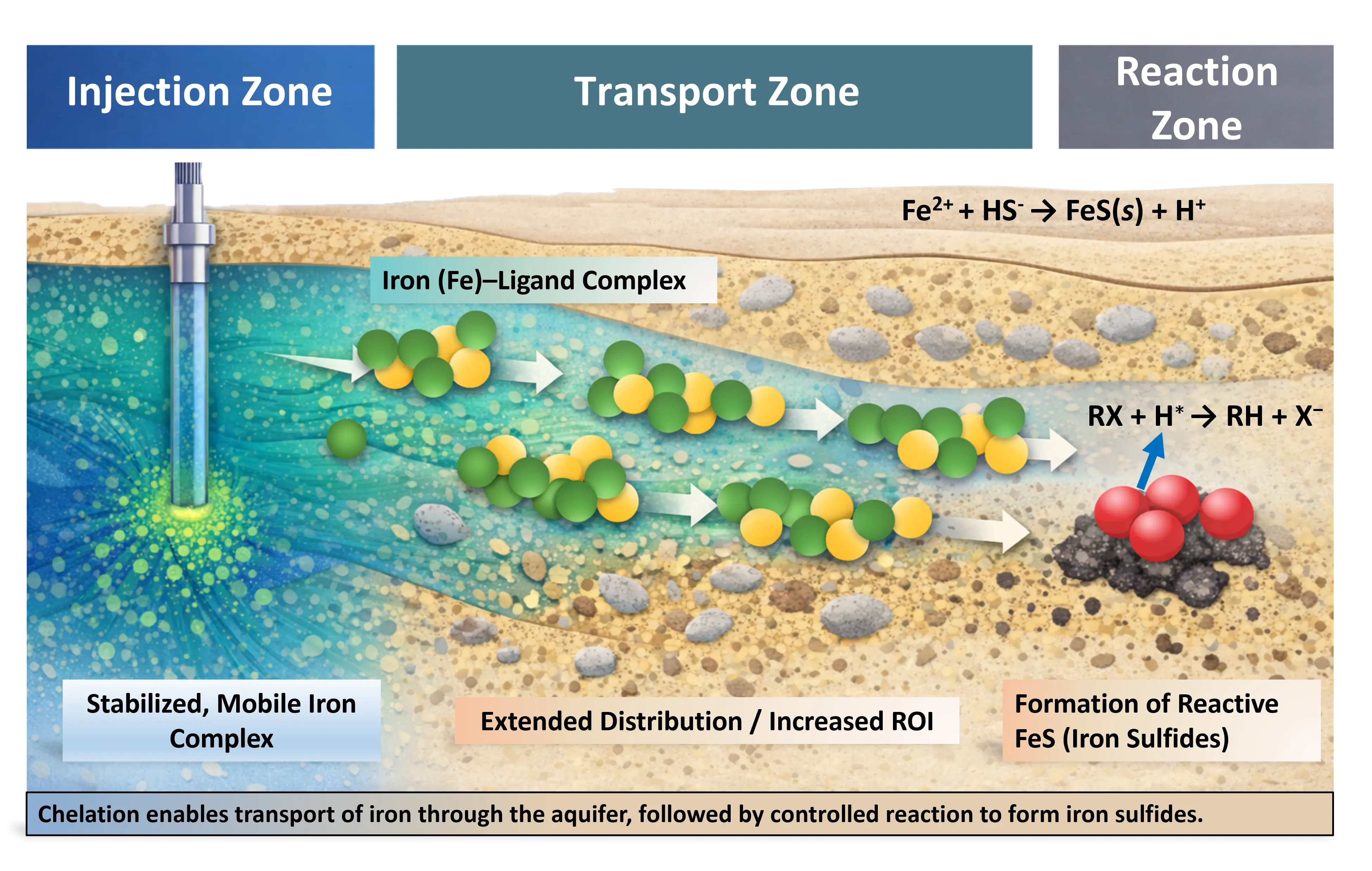
Chelation enables transport of Fe²⁺ away from the injection zone, followed by controlled release and formation of reactive iron sulfides (FeS) downgradient.
How It Works
BioBoost™ GeoChem is designed to control the speciation, transport, and reactivity of dissolved iron in subsurface environments.
The formulation utilizes chelation chemistry to stabilize ferrous iron (Fe²⁺) in solution, limiting rapid oxidation and precipitation near the injection point. This stabilization reduces the formation of iron hydroxides that can restrict permeability and hinder amendment distribution.
As the chelated iron migrates through the aquifer, changes in geochemical conditions—including redox potential, pH, and ligand exchange—promote the gradual release of Fe²⁺. This controlled dissociation enables iron to be distributed beyond the immediate injection zone.
Once released, ferrous iron reacts with dissolved sulfide (HS⁻), typically generated through sulfate-reducing microbial activity, to form iron sulfide (FeS):
Fe²⁺ + HS⁻ → FeS(s) + H⁺
The formation of FeS supports both abiotic and biogeochemical treatment mechanisms. Iron sulfides can facilitate reductive transformation of contaminants and contribute to the development of reducing conditions favorable for anaerobic biodegradation.
Through this sequence—stabilization, transport, and controlled release—BioBoost™ GeoChem improves the distribution of reactive iron and promotes the formation of treatment zones where they are most effective
APPLICATIONS
BioBoost™ GeoChem is designed for use in subsurface remediation systems where control of iron transport and reactivity can improve amendment distribution and treatment performance.
It is particularly well suited for applications involving coupled biogeochemical processes, where both biological and abiotic mechanisms contribute to contaminant degradation.
Chlorinated Solvents (CVOCs)
Supports treatment of compounds such as TCE, cDCE, and vinyl chloride by promoting the formation of reactive iron sulfides (FeS), which support abiotic reduction pathways while enhancing conditions favorable for reductive dechlorination.
Biogeochemical Treatment Systems
Applicable in systems designed to leverage interactions between iron, sulfur, and microbial processes to establish and maintain reducing conditions in the subsurface.
Co-Injection with Amendments
Compatible with electron donors (e.g., EDS-ER™), sulfate sources, and zero-valent iron (ZVI). Chelation improves iron transport, reduces premature precipitation, and enhances the development of reactive treatment zones.
Low-Permeability and Heterogeneous Formations
Chelation-enabled transport of iron can improve distribution in challenging subsurface conditions, increasing the likelihood of contact with contaminant mass.
CHLORINATED SOLVENT REMEDIATION
For chlorinated solvent sites, BioBoost™ GeoChem supports:
- Enhanced reductive dechlorination (ERD)
- Abiotic reduction of cis-1,2-dichloroethene (cDCE) and vinyl chloride (VC)
-
Improved performance and resilience of Dehalococcoides-based systems
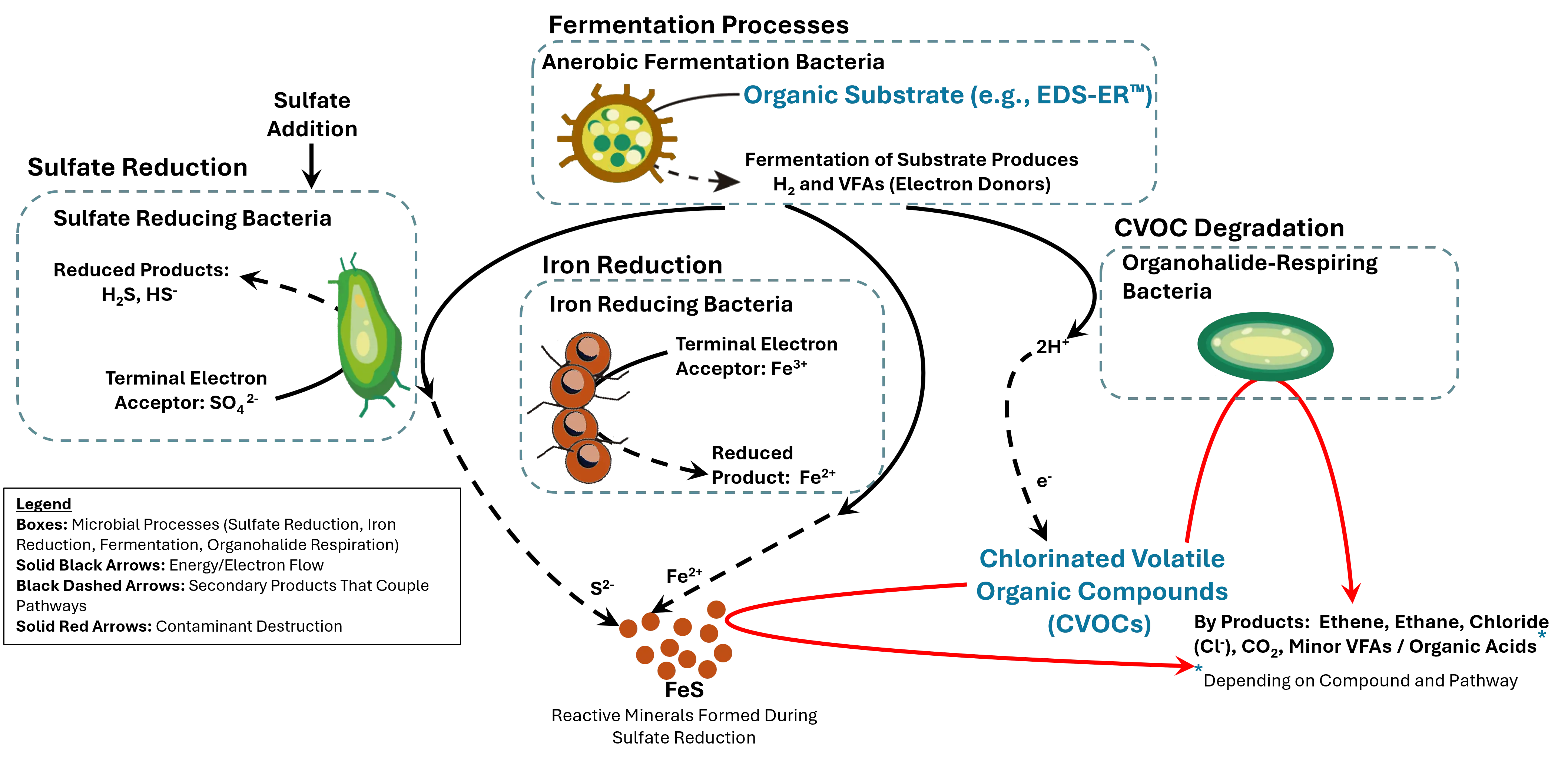 Iron sulfide minerals formed from BioBoost GeoChem™ have been shown to facilitate direct electron transfer reactions, accelerating dechlorination pathways that may otherwise stall at intermediate daughter products.
INTEGRATION WITH TERSUS TECHNOLOGIES
BioBoost™ GeoChem is commonly ap plied as a co-amendment with other Tersus Environmental technologies, including:
- EDS-ER™ emulsified vegetable oil electron donors
-
Zero-valent iron (ZVI) products
This integrated approach allows practitioners to design multi-mechanism remediation systems that combine biological activity with persistent geochemical reactivity.
Field BENEFITS
- Improves amendment distribution and radius of influence
- Reduces near-well fouling and injection pressures
- Enhances contact with contaminant mass
- Supports sustained reducing conditions downgradient
Design Considerations
Conventional iron delivery approaches often result in rapid precipitation near the injection point, limiting transport and effective distribution.
BioBoost™ GeoChem is designed to delay this reaction, allowing iron to move through the subsurface before forming reactive phases where they are most effective.
TYPICAL APPLICATION
BioBoost™ GeoChem is applied as an aqueous solution using standard groundwater injection methods. Application rates and amendment combinations are site-specific and should be developed based on site geochemistry, contaminant profile, and remediation objectives.
Tersus Environmental provides project-specific guidance to support optimal amendment selection, dosing, and integration with companion technologies.
Packaging
- 40-lb pail
